

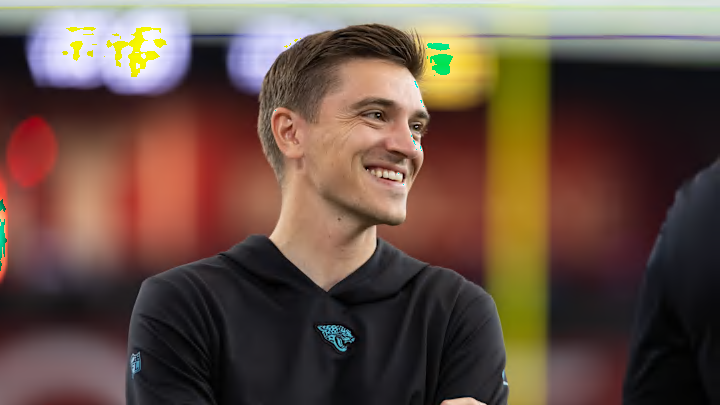
Roster construction often reveals more about organizational direction than splash acquisitions ever can. For the Jacksonville Jaguars and GM James Gladstone, the current phase of roster building points toward players who reinforce structure and coaching philosophy rather than those carrying early-round hype.
In offenses built on timing, spacing, and efficiency, functional fits frequently outperform bigger names whose skill sets require adaptation.
Gladstone hails from a Rams front office where GM Les Snead and head coach Sean McVay were in total lockstep on personnel decisions. You can bet Gladstone will do his best to emulate that in Jacksonville with Liam Coen — and that may include two 2026 NFL Draft targets in particular.
Jaguars could take the long view in 2026 NFL Draft with two ideal prospects for Liam Coen
Miami offensive tackle Markel Bell represents a player who could fit seamlessly into what Coen wants to do from a schematic standpoint.
At 6-foot-8, Bell’s value stems from length, pass protection consistency, and developmental upside rather than dominant run-game traits with a frame that allows him to widen rush paths and absorb speed off the edge -- traits that matter in offenses prioritizing pocket stability and deeper passing concepts.
Bell is not a finished product, particularly with leverage and lateral range, but his strengths align with a system that asks tackles to protect structure first, and for a team seeking affordable long-term answers rather than immediate star power, Bell projects as an early Day 3 option capable of growing into a starting role while stabilizing the offensive front in obvious passing situations.
At tight end, LSU’s Bauer Sharp fits a similar philosophical mold. A former quarterback, Sharp brings processing ability and spatial awareness that translate well to modern offensive design. But where his value lies is in his alignment versatility.
Sharp can align in-line (Y-TE), shift across formations, or operate as a short-area target without forcing substitution changes that tip offensive intent. That flexibility allows play callers to maintain tempo and disguise personnel usage, an always growing priority across football. While he may never command high target volume, Sharp’s willingness as a blocker and reliability underneath make him a functional complement within multi-tight end groupings.
The connection between Bell and Sharp is not production or national recognition, rather, it's how their traits support offensive continuity. Bell could help maintain clean pockets and offensive rhythm for Trevor Lawrence, while Sharp allows formations to remain balanced between run and pass without sacrificing efficiency.
Both players project as role-specific contributors whose value increases when deployed within a clearly defined system.
For Jacksonville, that approach reflects a broader shift toward scheme-driven roster construction. Coaching identity increasingly dictates personnel decisions, and mid-tier additions often determine whether an offense operates smoothly over the course of a season.
Bell and Sharp exemplify how teams can improve without chasing star power, instead targeting players whose skill sets quietly make the system work as intended.
 Add us as a preferred source on Google